> For the complete documentation index, see [llms.txt](https://lang.gitbook.io/en/llms.txt). Markdown versions of documentation pages are available by appending `.md` to page URLs; this page is available as [Markdown](https://lang.gitbook.io/en/conlangs/creations/numbers.md).

# Numbers

Numerals are a sort of script, although their visual structure typically melds with the linguistic script in which they are used.

{% hint style="success" %}

* *Numbers* are the quantity value.
* *Numerals* are the visual glyph symbols that represent numbers.
  {% endhint %}

## My Numerals

I have created my own numeral glyphs, based on my own method of shape derivation.&#x20;

Since coming up with them, I've also become very interested in "Dozenal", a name for the Base-12 counting system, also known as Duodecimal. (The name "Dozenal" is preferred by proponents because the name "Duodecimal" implies a dependency upon the decimal system as a "default" system.)

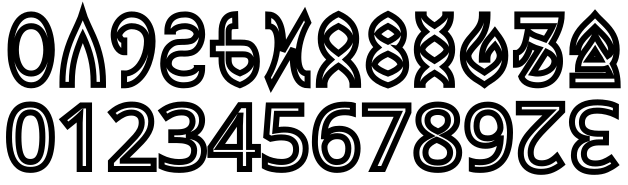
Here are my own numerals, from zero up to nine, dex and elf:

<figure><img src="https://2005627275-files.gitbook.io/~/files/v0/b/gitbook-x-prod.appspot.com/o/spaces%2FXnkY7B2X6Gqn7ivud1qr%2Fuploads%2FcB1TfS57UEfTSROOoldd%2FDozenal%20Numerals%20in%20Dot%20Derived%20form.svg?alt=media&amp;token=4720262c-a047-4c66-9032-3ecf12aa21ee" alt=""><figcaption></figcaption></figure>

In the Dozenal system, there are two additional numbers prior to the equivalent of "ten". Depending who you ask or what you read, these are ascribed different symbols and names. I have opted for what I believe is both the most cohesive and sensibleː

<table><thead><tr><th width="133">quantity value</th><th>Dozenal name</th><th>Unicode point</th></tr></thead><tbody><tr><td>9 + 1 </td><td>"dex" from Latin for 10</td><td><kbd>↊</kbd> — turned digit two</td></tr><tr><td>9 + 2</td><td>"elf" from "eleven", "elf" (German), meaning "one left over"</td><td><kbd>↋</kbd> — turned digit three</td></tr><tr><td>9 + 3</td><td>"do" /dəw/, to distinguish from the decimal naming of "ten", "-teen" and "-ty". Fulfills all three spaces, with "do" 10, "do-four" 14, and "four-do" 40.</td><td>10 — but I would like to distinguish Dozenal 0 as <kbd>ʘ</kbd>.</td></tr></tbody></table>

The shapes of my numerals are derived from quantities of dots in a tight grid pattern. Each numeral's line is the path taken in order to pass through all the dots and provide a somewhat discernible structure.&#x20;

To provide realism, some of the lengthier paths have been relaxed so that the glyphs are more sane for writing in day-to-day life — nobody is going to consistently write a numeral that has too many twists, turns, corners and loops!&#x20;

Dex and Elf are somewhat longer, but their fundamental shapes are distinct enough from the other numeral glyphs that they will not lose fidelity when they inevitably evolve through being written fast, and lose their original form.

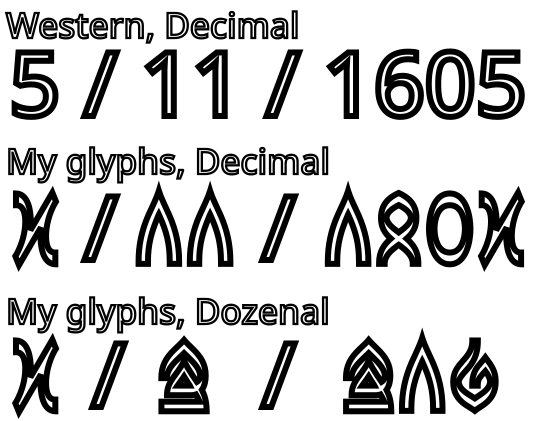
Here's an example of the numerals in use:

<figure><img src="https://2005627275-files.gitbook.io/~/files/v0/b/gitbook-x-prod.appspot.com/o/spaces%2FXnkY7B2X6Gqn7ivud1qr%2Fuploads%2FSGthYZjn8g2n38mE3sMD%2FExample%20-%205th%20Nov%20date%20-%20dot%20derived%20-%20dozenal.svg?alt=media&amp;token=37649e6f-b7d7-4673-a9e1-e6c18aaeb7c1" alt=""><figcaption></figcaption></figure>

The third version, in Western numerals, reads: <kbd>5/↋/↋19</kbd>.

You can convert values between base 10 and 12 using [this website here](https://www.unitconverters.net/numbers/base-10-to-base-12.htm).

***

## Existing numeral systems

### Brahmic scripts

Burmese numbers look exactly like the Burmese abugida's letters:

<table data-header-hidden><thead><tr><th width="111"></th><th width="219"></th></tr></thead><tbody><tr><td><a data-footnote-ref href="#user-content-fn-1"><strong>Letters</strong></a></td><td>ဝ င ရ န မ ဈ ဖ ဌ ဒ</td></tr><tr><td>Numerals</td><td>၀ ၁ ၂ ၃ ၄ ၅ ၆ ၇ ၈ ၉ </td></tr></tbody></table>

This holds true for all the Brahmic scripts.

### Hanzi, Kanji, Hanja — CJK

CJK numbers are visually coherent with CJK ideographs:

<table><thead><tr><th width="96" valign="top"></th><th width="229" valign="top">ideographs</th><th width="434" valign="top">numerals</th></tr></thead><tbody><tr><td valign="top">Chinese</td><td valign="top">所有人生而自由，在尊嚴和權利上一律平等。</td><td valign="top"><p>〇 一 二 三 四 五 六 七 八 九 十</p><p>líng yī èr sān sì wǔ liù qī bā jiǔ shí</p></td></tr><tr><td valign="top">Japanese</td><td valign="top">すべての人間は自由であり、尊厳と権利において平等に生まれる。</td><td valign="top"><p>〇 一 二 三 四 五 六 七 八 九 十</p><p>れい いち に さん し ご ろく しち はち く じゅう</p><p>まる ひと ふた みっ よん いつ むっ なな やっ ここの とお</p></td></tr><tr><td valign="top">Korean</td><td valign="top">所有人類은 生來부터 自由롭고 尊嚴性과 權利에 있어서 平等합니다. [<a data-footnote-ref href="#user-content-fn-2">Hangeul version</a>]</td><td valign="top"><p>零 一 二 三 四 五 六 七 八 九 十</p><p>령 일 이 삼 사 오 륙 칠 팔 구 십</p><p><a data-footnote-ref href="#user-content-fn-3">( )</a> 하나 둘 셋 넷 다섯 여섯 일곱 여덟 아홉 열</p></td></tr></tbody></table>

As you can see, all of the numeral glyphs are identical between the three scripts. Both Japanese and Korean have native number names and adopted names from Chinese. The numeral glyphs fit cohesively with the CJK Hanzi, Kanji, Hanja ideographs.

### Western scripts

Some numerals are just modified to fit the linguistic script's appearance, but they are still fundamentally the same basic glyphs. For example, "Western" numerals are actually originally Arabic and/or Hindu (there may be some controversy around this), and if you compare the numeral glyphs from each, you can see that they are (mostly) fundamentally the same glyphs. Their visual differences are akin to the differences between typefaces, and bring them into coherence with their respective linguistic scripts.

examples

### Others which I have yet to research

...

***

[^1]: **Just some randomly chosen letters to give you a feeling of the script.**

[^2]: 모든 인간은 태어날 때부터 자유롭고 존엄성과 권리가 평등합니다.

[^3]: Korean has no native word for Zero.